
Organized Enough: Home Organizing Systems That Actually Work for ADHD Families
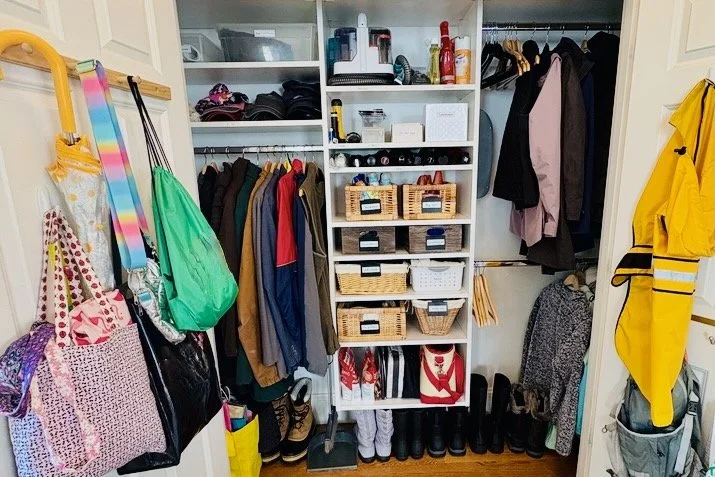
Not a magazine closet. A working one. Bags on hooks where they get dropped, open baskets with simple labels, and boots lined up right by the door.
If you’ve ever carefully labeled every bin, created what seemed like a brilliant storage system, and organized the family calendar, only to watch the whole thing unravel within a few days, you may know this feeling.
You did everything you were supposed to do. Everything has a place. The system makes perfect sense. So why are the shoes still in the hallway, the backpack on the kitchen floor, and the papers you carefully filed somehow missing when someone needs them?
If you live with someone who has ADHD, whether it’s your child, your partner, or another person you love, you’ve probably learned that a beautifully organized system isn’t necessarily a system that will actually work for your family.
I’ve had to learn this too.
I love order. I love a calm space and knowing exactly where something belongs. But I’ve also learned, both in my own home and through my work as an organizer, that organizing isn’t about getting everyone in the house to follow the system I think should work. It’s about figuring out what will make everyday life easier for the people who actually live there.
Sometimes that means letting go of what “organized” is supposed to look like and settling for something I think is much better: organized enough.
Why Traditional Organizing Systems Don’t Always Work With ADHD
A lot of traditional organizing advice sounds perfectly reasonable. Put something away as soon as you're finished with it. File papers where they belong. Make a list. Create a routine and stick with it.
The problem is that a system can be logical and still ask too much of the person who is supposed to use it.
In my experience, ADHD can make remembering, organizing, and getting started on a task much harder than it looks from the outside. So something that looks like one simple step to one person may actually involve several steps to someone else.
That has changed the way I think about organizing.
Instead of asking, "Why won't they use the system?" I think the better question is, "What is it about this system that isn't working?"
Sometimes the answer is surprisingly small.
Make It Easier to Put Something Away
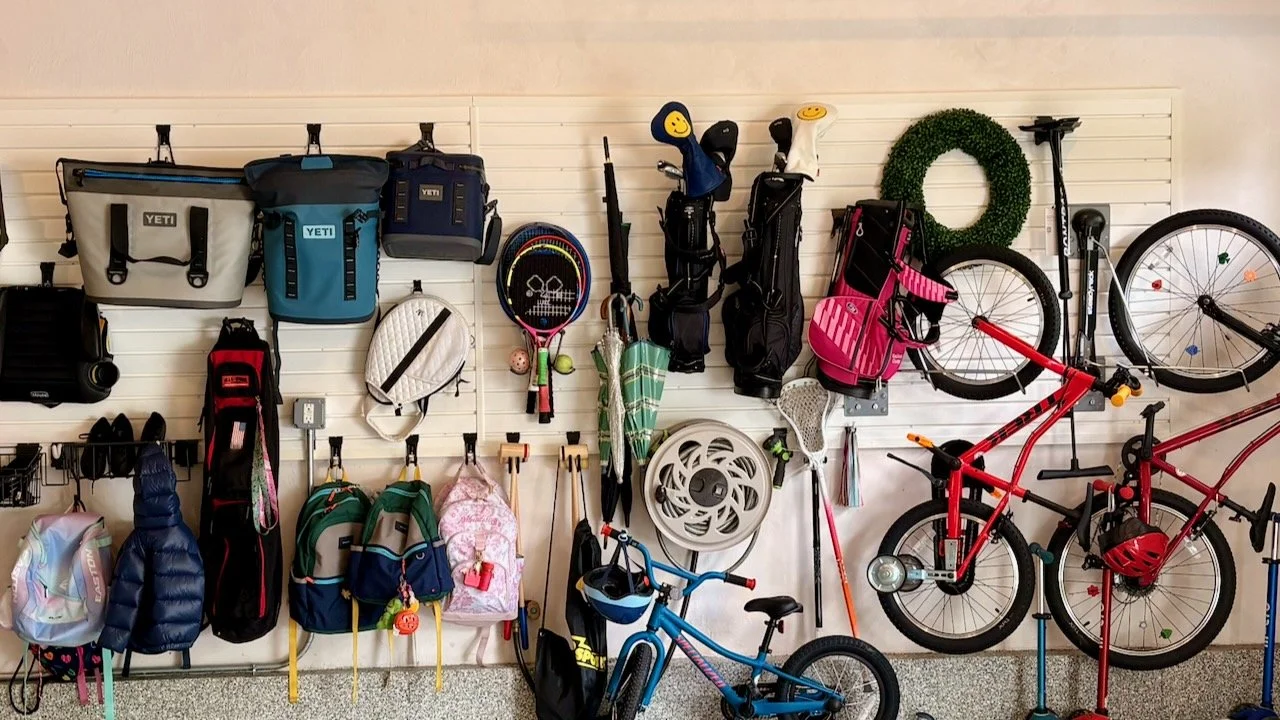
If backpacks land in the garage, that's where the hooks go. Every bag, bike, and racket has a spot you can reach in one step.
One of the things I pay attention to when I’m organizing a home is how many steps it takes to put something away.
Let’s say the laundry hamper is inside a closet, behind a closed door, with a lid on top. To put dirty clothes away, you have to open the closet, walk in, lift the lid, put the clothes inside, close the lid, and close the door.
That doesn’t sound terribly complicated, but if the clothes are consistently landing on the floor right outside the closet, the location is telling us something.
Maybe the hamper belongs exactly where the clothes are already landing.
The same idea applies all over the house. If backpacks are always dropped by the door, perhaps that’s where the hooks belong. If shoes collect in one particular spot, put a basket there instead of trying to convince everyone to carry them somewhere else. If opening a box, putting something inside, and replacing the lid is enough to keep the box from being used, try an open bin.
I call this reducing the friction. You aren’t lowering your standards or giving up on having an organized house. You’re removing unnecessary steps between “I’m finished with this” and “this is put away.”
That small shift can make a huge difference.
Let the House Tell You Where Things Belong
Sometimes we choose where something should live because that’s where it traditionally belongs. Coats go in the coat closet. Mail goes in the office. School supplies go upstairs in a desk.
But if nobody ever takes the mail to the office, what have we accomplished besides creating a pile on the kitchen counter?
Instead, I like to look at where things naturally land.
If homework happens at the kitchen table, perhaps pencils, chargers, and school supplies need to live nearby. If everyone takes off their shoes at the back door, that’s where the shoe storage belongs. If permission slips are constantly being forgotten because they’re tucked inside a folder somewhere, perhaps you need one visible place for papers that require action.
Organizing around the way your family already moves through the house is usually much easier than trying to train everyone to move through the house differently.
This is true in every home, by the way. ADHD just has a way of making an overly complicated system reveal itself very quickly.
Sometimes Out of Sight Really Does Become Out of Mind
I’m usually a fan of putting things away. Visual clutter can make a room feel busy, and I love the calm that comes from having clear surfaces.
But there are times when hiding everything behind cabinet doors works against the person who needs to remember it’s there.
If someone regularly forgets about something once it’s tucked away, we can find ways to make important things more visible without letting the whole house become cluttered.
A clear bin might work better than an opaque one. A labeled basket on a shelf may work better than a drawer. A hook near the door can be better than a coat closet. A small tray for keys and a wallet can be much more effective than deciding those things “should” go upstairs.
The goal isn’t to leave everything out. It’s to be thoughtful about what needs to be seen and what can comfortably disappear behind a door.
There is a big difference between visual clutter and a visual reminder.
Give the Things That Wander a Home
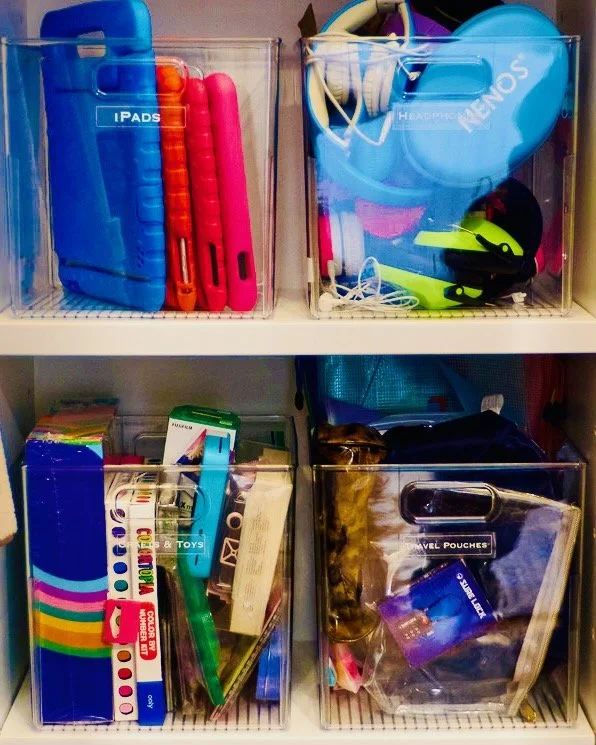
iPads and headphones finally have a home, and clear bins mean nobody has to remember what's inside.
Every family seems to have certain things that travel around the house.
Chargers. Water bottles. Shoes. Mail. Sports equipment. Headphones. School papers.
If you’re constantly picking up the same objects from the same places, stop for a minute before putting them away again. The problem may not be that your family isn’t organized. The problem may be that those things don’t have a home that makes sense.
One of my favorite organizing questions is simply, “Where would you look for this?”
Not where should it go. Where would you actually look for it?
The answer is often a much better organizing solution than anything I could invent on my own.
Labels Can Help, but Only if They Actually Mean Something
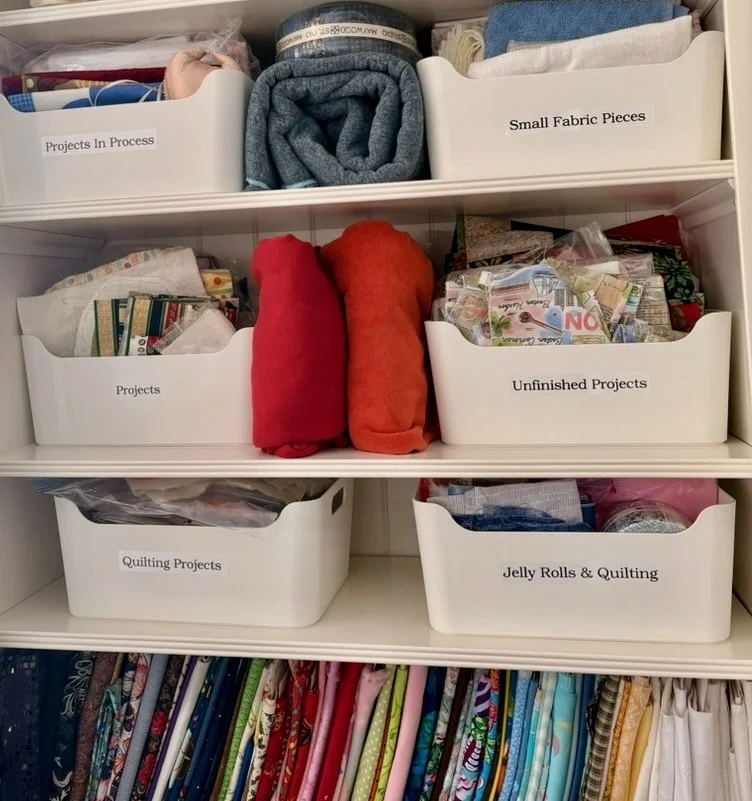
Broad, honest labels work. There is even a bin for unfinished projects, because every home needs one.
I love a label. This will surprise absolutely no one who knows me.
But a label is only useful when it helps the person using the space make a quick decision.
A bin labeled “Miscellaneous” doesn’t really tell anyone anything. Neither does a complicated filing system with twenty categories that nobody can remember.
Keep categories broad and obvious whenever you can. “School,” “Cords,” “Dog,” “Returns,” and “Things That Go Upstairs” may not win an award for sophisticated organizing, but if everyone understands what belongs there, the system is doing its job.
And yes, I am completely comfortable with a basket labeled “Things That Go Upstairs.”
If it stops six pairs of socks, a hairbrush, two books, and someone’s sweatshirt from living on the stairs, I’m calling that a win.
Build in a Reset Instead of Expecting Perfection
This may be the biggest thing I’ve learned.
A good organizing system isn’t one that never gets messy. It’s one that is easy to reset when it does.
Life happens. There are busy school weeks, late work nights, sports seasons, illnesses, vacations, and stretches when nobody has the energy to put everything back exactly where it belongs.
Instead of seeing that as proof that the system failed, I like to build resetting into the system from the beginning.
Maybe Sunday afternoon is when the backpacks get emptied and the papers get sorted. Maybe ten minutes before dinner is enough to put the main living space back together. Maybe everyone grabs the things that belong to them and does one trip through the house.
It doesn’t need to become a giant weekend cleaning project. In fact, the easier the reset is, the more likely it is to happen.
If resetting a room takes two hours, we probably need to look at the room again.
Your Child’s Room Doesn’t Have to Work the Way Yours Does
This can be a hard one for parents, especially those of us who genuinely enjoy being organized.
Your child’s version of organized may not look like yours.
Maybe folding every T-shirt and putting it into a dresser isn’t realistic, but tossing clean shirts into a labeled bin works perfectly well. Maybe books need to stand in a basket instead of being arranged neatly on a shelf. Maybe the closet doors are part of the problem and an open hook works better for the sweatshirt that gets worn every day.
Before changing your child’s room, involve them in the process. Ask what is annoying about the current setup. Ask where they look for things. Ask which part of getting ready in the morning is always difficult.
You may get an answer you never would have thought of yourself.
What helps one child may distract or frustrate another, which is exactly why their input matters. We aren't trying to create the perfect ADHD bedroom. We're trying to create a bedroom that works for your child.
The Same Goes for Your Partner
Sharing a home with another adult always involves some negotiation, whether ADHD is part of the picture or not.
One person’s “I’ll deal with that later” pile may be another person’s “I cannot relax while that is sitting there” pile.
This is where I think organizing can become less about containers and more about communication.
If one person needs to see something to remember it and the other needs clear surfaces to feel calm, neither person is necessarily wrong. We just need a system that respects both needs.
Maybe there’s a designated visible spot for active paperwork rather than papers covering the entire kitchen island. Maybe a basket contains the things that need attention. Maybe keys, glasses, and wallets live in an open tray, but everything else gets tucked away.
The goal isn’t for one person to win the organizing argument. It’s for both people to be able to live comfortably in the same house.
Be Careful With “Should”
I’ve heard a lot of “shoulds” over the years.
I should be able to keep this clean.
My teenager should remember to put this away.
We should be more organized by now.
This shouldn’t be so hard.
“Should” isn’t terribly helpful when you’re trying to solve an organizing problem.
I’m much more interested in what is actually happening. Where does the backpack land? What gets lost every morning? Which pile keeps coming back? What part of the routine consistently falls apart?
Those aren’t character flaws. They’re information.
Once we stop judging the problem, we can usually see it much more clearly.
What Does “Organized Enough” Look Like?
For me, an organized home isn’t a house where nothing is ever out of place.
It’s a house where you can find what you need. The important things don’t regularly disappear. Everyone knows, more or less, where things belong. The systems aren’t so complicated that maintaining them becomes another full-time job.
And when the house gets messy, because every house does, you can find your way back without having to start from scratch.
If ADHD is part of your household, that might mean open bins instead of matching boxes with lids. It might mean hooks instead of hangers, fewer categories instead of more, a basket where things naturally pile up, or a reminder that’s visible instead of hidden inside a beautifully organized drawer.
It might not look like the organizing system you imagined.
But if your mornings are easier, fewer things are getting lost, there’s less frustration in the house, and everyone can participate in maintaining it, I would say the system is working.
That’s organized enough for me.
Let Your Home Work for the People Who Live There
Living with ADHD in the house has taught me something I probably needed to learn anyway: organizing isn’t about making people behave more like organized people.
It’s about making the home support the people who live there.
Sometimes the best organizing solution isn’t prettier. Sometimes it’s a basket in an unexpected place, an open bin, a hook on the wall, or a routine that gets abandoned for two weeks and then started again.
That’s okay.
Your home doesn’t need a perfect system. It needs systems that your family can actually use.
If you’re in Needham, Wellesley, Newton, Dover, Westwood, or another nearby MetroWest community and your home feels like it’s fighting against the way your family actually lives, I’d be happy to help you look at it differently. I can simplify what’s complicated, rethink what isn’t working, and create a home that feels a little easier to live in.
Not perfectly organized.
Organized enough.
Love,
Merrie