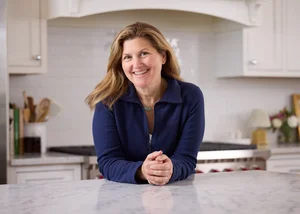

From mom to move manager: Studio apartment organizing tips from NYC
A few years ago, I helped both of my daughters move into their first studio apartments in New York City. Two different neighborhoods, two very small spaces, and two very big life moments.
I will be honest with you: I did not show up on those move-in days as just their mom. I was also an organizer, and I could not turn that part of me off even if I tried. I arrived with a measuring tape, a notebook, strong opinions about furniture placement, and approximately seventeen opinions about cabinet organization. My daughters were thrilled, obviously. What I left with was something I did not expect: a renewed love for this work, and a handful of lessons that have followed me home to every client since.
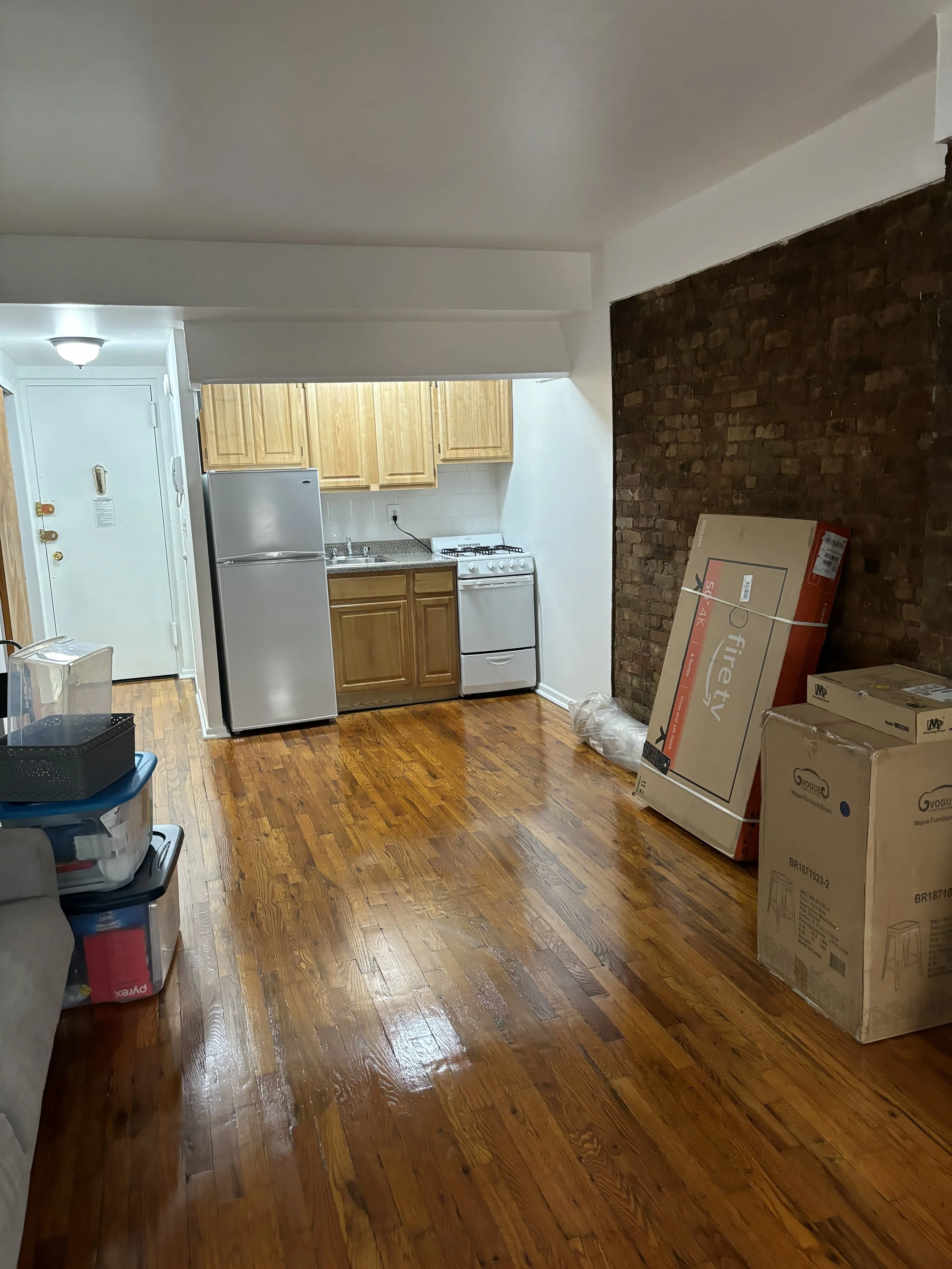
The blank canvas. Hardwood floors, good bones, and all the possibility in the world. This is the before.
The Real Challenge of a Tiny Apartment
Let's be honest: tiny apartments come with big challenges. But they are also full of potential. And purpose. And, if you're lucky, a corner by the window that catches the morning light just right.
Here is what I have learned: the challenge with a studio apartment isn't actually the size. It's that every single item has to earn its place. There is no spare bedroom to absorb overflow. No mudroom to collect the things you haven't dealt with yet. No basement where boxes go to be quietly forgotten (and rediscovered three years later when you move again). In a studio, every item is visible, and every item has a cost, either in square footage or in mental energy.
That kind of pressure can feel overwhelming at first. But it can also be clarifying in the best possible way. When you can't keep everything, you have to get honest about what actually matters. That kind of clarity has a way of following you, long after move-in day.
What We Actually Did (And How We Thought About It)
Helping my daughters settle in wasn't just about measuring furniture or finding the perfect shelves to hold their collections of beloved novels, scripts, and playbills (although yes, we absolutely did that). It was about something deeper: editing their belongings down to the essentials while preserving the things that made their new spaces feel like them.
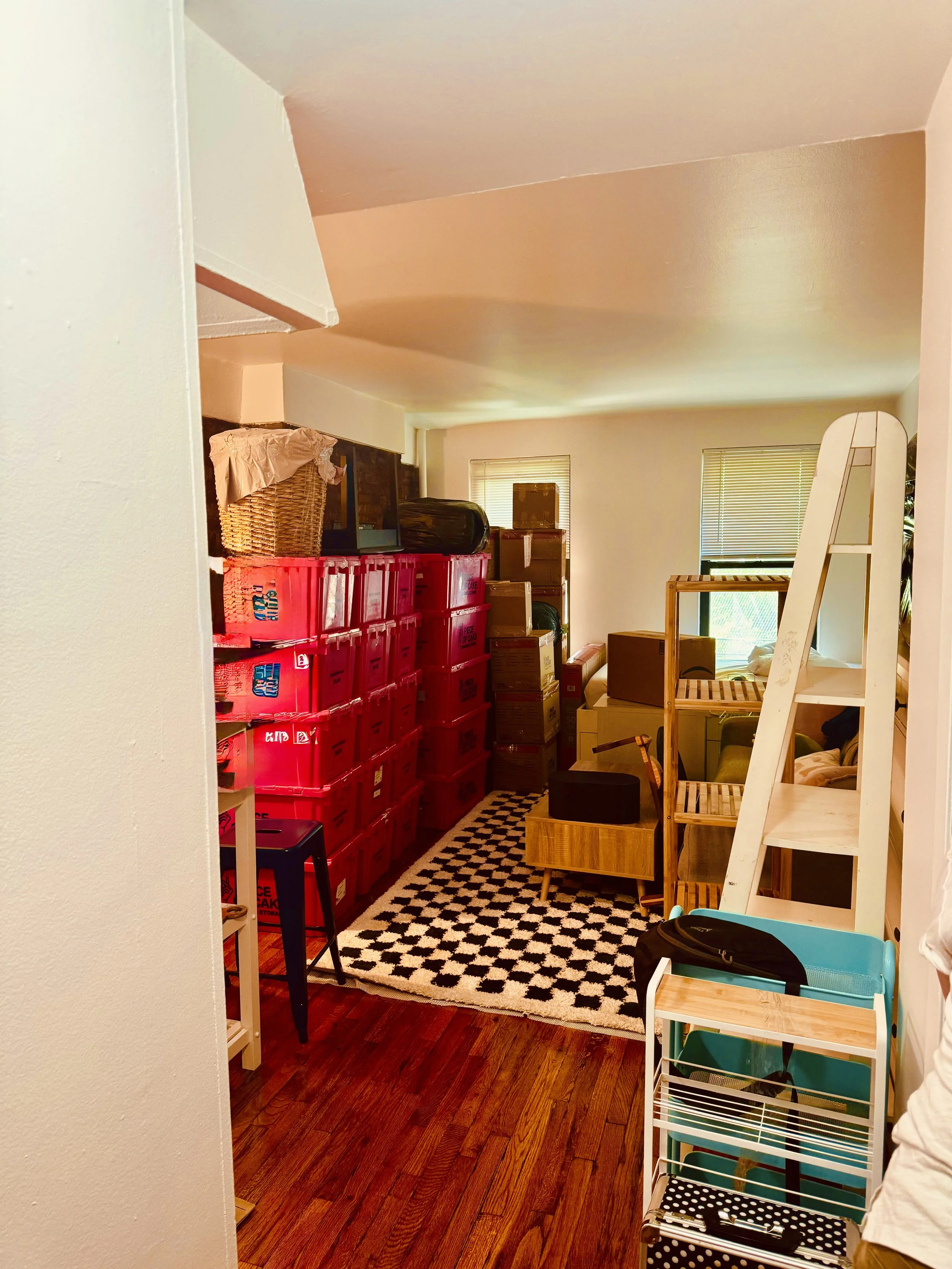
The organized chaos of move-in day. Eco-friendly packing bins, cardboard boxes, and a whole lot of positivity
I should note, for the sake of full transparency, that "edited down to the essentials" is a generous description. There is still a corner of Mom's attic that would tell a very different story. But we did our best, and I stand by it.
Here is how we approached each space, and what I'd suggest if you're facing something similar:
Start with the anchor piece and work outward. In a studio, the bed is the anchor. Everything else flows from where that lands. Once we found the best placement for the bed, the rest of the layout started making sense on its own. Both apartments also got the IKEA Brimnes storage bed, and if you haven't discovered these yet, they are a genuine game-changer in a space with nowhere to hide things.
Name the non-negotiables before you start editing. For one daughter, non-negotiable meant her books. Full stop. Zero discussion. For the other, it was her makeup, her crafting supplies, and a very particular collection of crystals and candles that has followed her faithfully through every move. Knowing the non-negotiables gives you a framework for everything else, and saves a lot of back-and-forth.
Give every category a home. Kitchen things in the kitchen. Work things at the desk. Personal care on a specific shelf. This sounds obvious, but it is the foundation of every organized space regardless of size. When everything has a designated spot, a small space doesn't feel chaotic. It feels intentional.
Use your vertical space. Walls are square footage too, and they are almost always underused. Floating shelves, over-door hooks, a well-placed pegboard: these can double the functional storage in a small apartment without adding any visual weight to the space.
Make everything do more than one job. A desk that moonlights as a makeup table. A coffee table that pulls up to the couch for dinner. A storage ottoman that is simultaneously a footrest, an extra seat, and a hiding spot for everything you don't want to deal with right now. In a small space, furniture that serves only one purpose is a bit of a luxury. The more jobs a piece can hold, the harder it earns its square footage.
Hold things lightly. Not everything made it into the new apartments, and that was okay. Letting something go doesn't mean it didn't matter. It just means it belongs to a different chapter. Some of the most freeing moments in organizing happen when you give yourself permission to say that.
The Things That Stayed (And Why They Mattered)
What I remember most from those move-in days isn't the furniture arrangement or the shelf styling, though I do remember those too, because I am who I am and I cannot help it. What I remember is the editing. More specifically, what we chose to keep.
The mismatched mugs from home. The photos they have lovingly taped to their walls since age 14. A candle that smells like the beach, like summers, like childhood, like the thing we still call home even though we don't all live there together anymore.
These weren't clutter. They were anchors.
There is a version of organizing that is very focused on paring down: fewer things, cleaner surfaces, a certain kind of austere minimalism. I understand the appeal. I do not practice it that way, and I never have. My job is not to talk you out of the things that matter to you. My job is to help you figure out which things those are, and then to make sure they have a proper place.
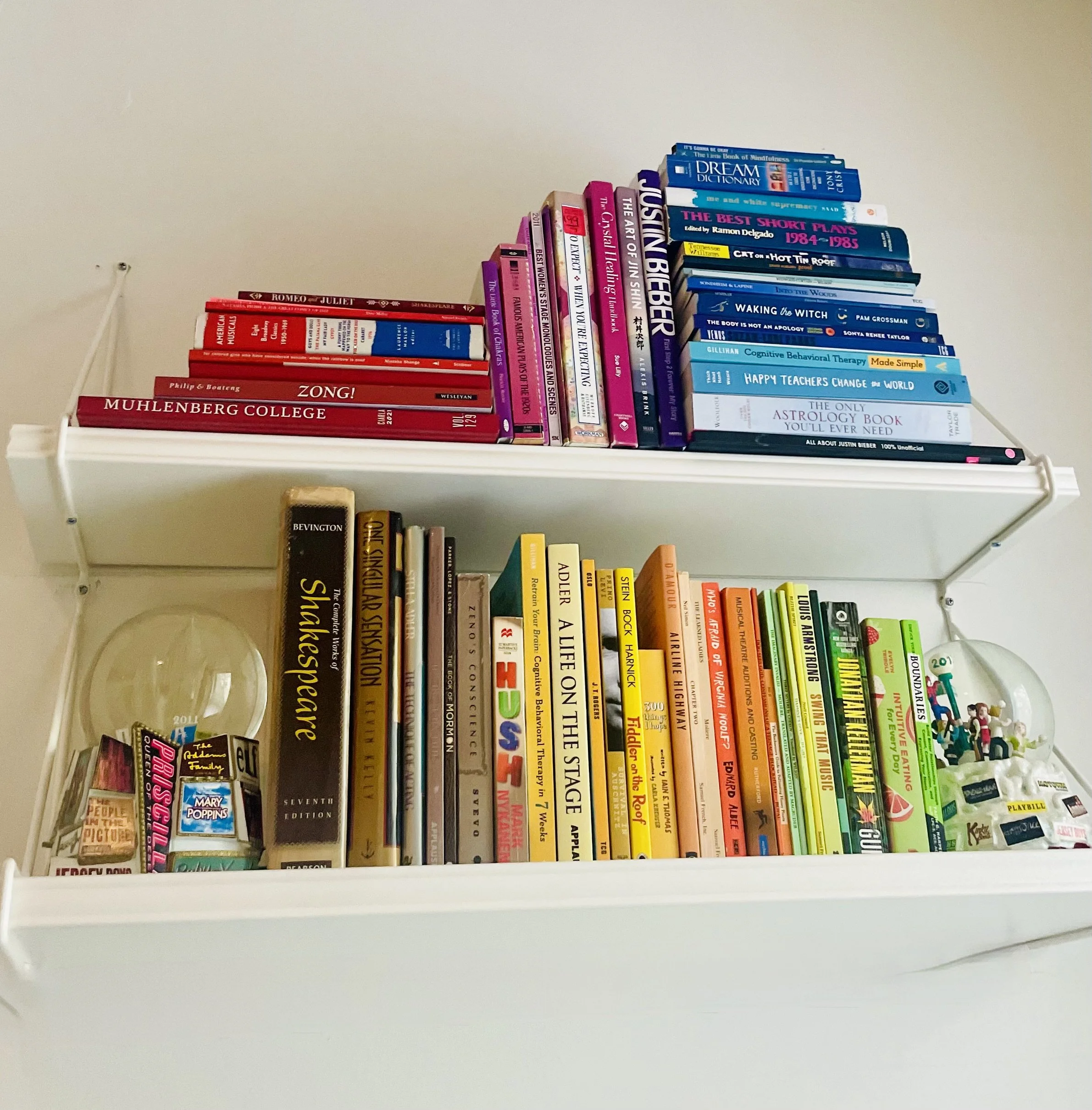
When your daughter's non-negotiable is her book collection, you make it beautiful. Every shelf organized by color, with playbills, Shakespeare, and a snow globe tucked in for good measure.
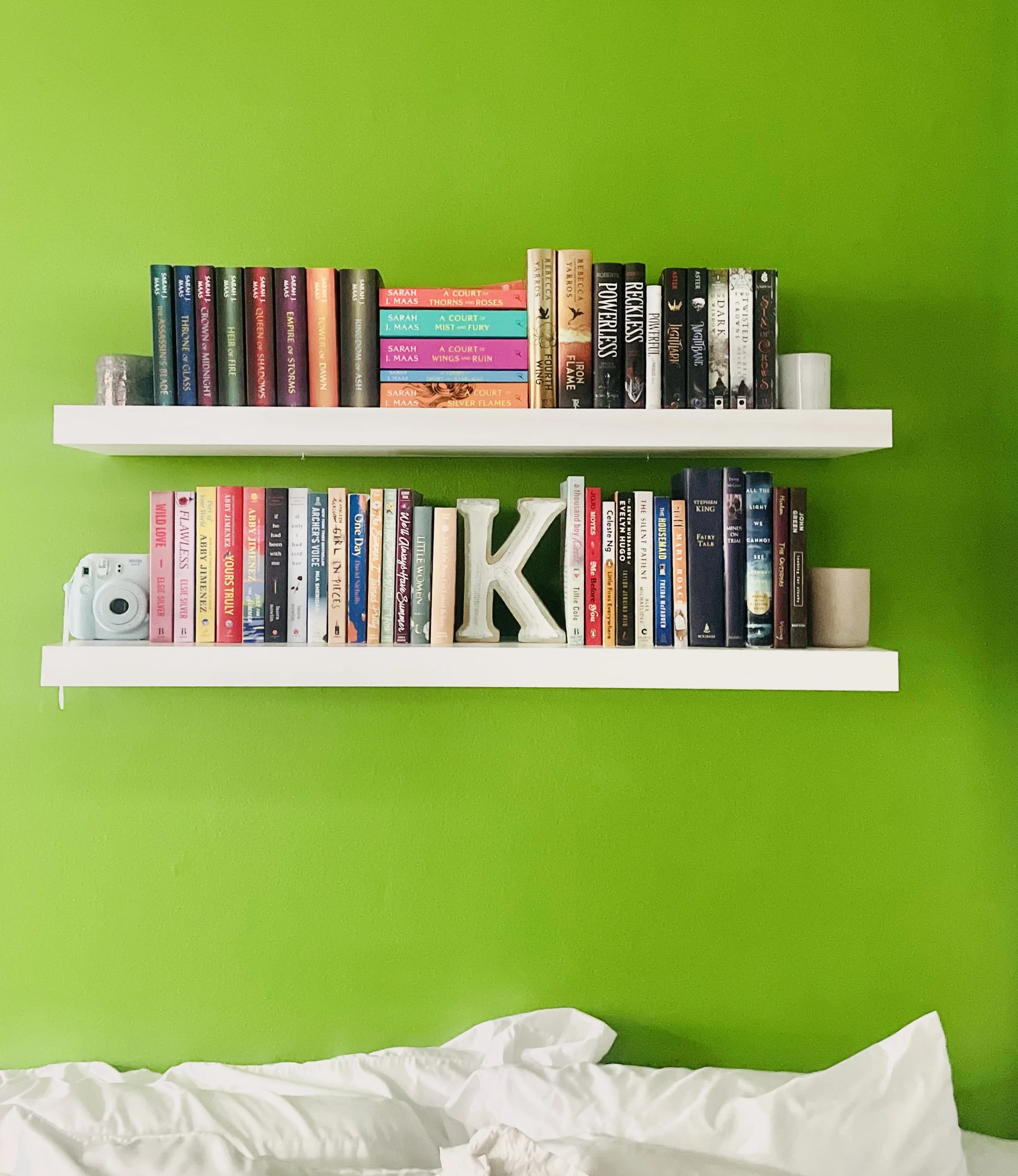
Floating shelves, a "K" for her name, an Instax camera, and enough Sarah J. Maas to last a very long winter. This is what non-negotiables look like in practice.
We didn't try to make my daughters' apartments look like something out of a magazine. Well, at least I didn't. They are Gen Zers, after all, and they had very strong thoughts about gallery walls, vintage lamps, and a neon sign that I have chosen, lovingly, to simply not comment on. We made those apartments look and feel like them. And that, my friend, is the whole point.
What Small Spaces Teach Us About Spaces of Any Size
That experience reminded me of something I believe deeply: the principles that make a tiny space work are the same principles that make any space work. The square footage changes. The logic does not.
Whether I am working in a 400-square-foot studio or a four-bedroom colonial in Wellesley, I am always asking the same questions:
What does this household actually need on a daily basis?
What is getting in the way of that?
What here carries meaning, and what is just occupying space?
What systems would make this easier to live in and easier to maintain over time?
These questions do not have universal answers. They have your answers. Finding them is the work.
I believe every home should reflect the people who live in it, not some universal ideal of what "organized" is supposed to look like. The home that works for a family of five in Dover is not going to look like the home that works for a newly retired couple in Natick. Both can be beautifully organized. Neither should look like a catalog.
How to Apply These Lessons to Your Own Space
If you are in the middle of a move, a downsize, or just a home that has quietly stopped working the way you need it to, here are some starting points:
Name your anchors first. Before you start sorting or purging anything, identify the non-negotiables. The things that come with you no matter what. These become your framework for every other decision.
Let go of someone else's version of "organized." Clean lines and minimalism are beautiful, but they are not the only path to an organized home. A home full of books and color and collected things can be deeply organized if everything has a place and a purpose.
Think in categories, not rooms. Group like things together across the whole house: all the candles, all the charging cables, all the baking equipment. When you can see an entire category at once, decisions get a lot easier.
Use your vertical space, and ask more from your furniture. Hooks, shelves, drawer dividers, stackable containers: these are not boring. They are genuinely transformative, and your walls will thank you. And before you buy a single new piece, ask what else it can do. A bench with storage, a dining table that folds against the wall, a bed with drawers underneath: every piece that pulls double duty is one fewer thing you need to find room for.
Give yourself permission to do it in stages. Move-in day does not have to be perfect. Get the important systems in place, live in the space for a bit, and then refine. The best organizing decisions usually come after you've had a chance to see how you actually move through a space.
Ask for help when you need it. There is no shame in calling in a professional. Sometimes all a space needs is someone who can walk in fresh, see it without any baggage, and say, "what if we tried it this way?"
Love,
Merrie
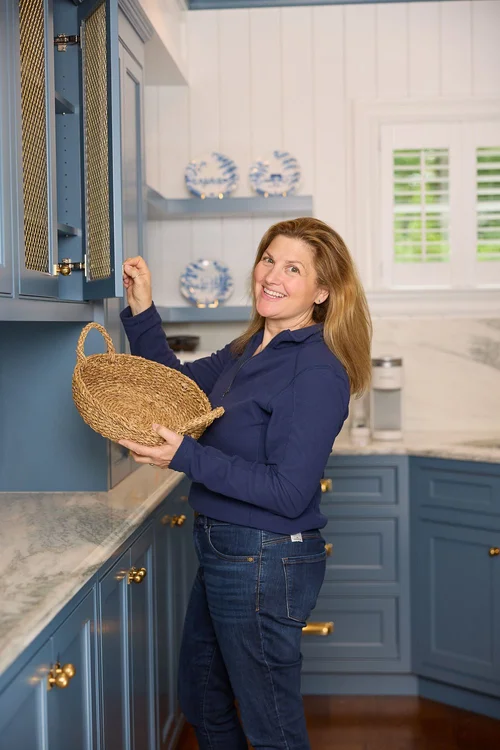
Hi! I'm Merrie. I find joy in creating cozy, tidy, and welcoming spaces by helping people reclaim their homes as havens of peace and comfort, whether they're navigating a new season, managing a busy household, or simply craving calm. My gentle, collaborative approach ensures every step honors your pace and story. Together, we'll design systems that are beautiful, functional, and sustainable, so you can spend less time overwhelmed and more time truly at home.